
Blog
Emerging Techniques to Identify Cyber Threats Daily
A Practical Guide for Everyday Users and Future Cybersecurity Professionals
By NextGen Wisdom Pakistan
In today’s digital world, cyber threats are no longer targeting only large organizations. Every smartphone user, student, employee, freelancer, and business owner can become a target.
The good news?
Modern cybersecurity techniques are helping individuals and organizations identify threats before they become serious incidents.
The challenge is awareness.
Most successful cyber attacks do not start with advanced hacking techniques. They start with a simple mistake made by a user.
Let’s explore some emerging techniques that can help identify cyber threats in our daily lives.
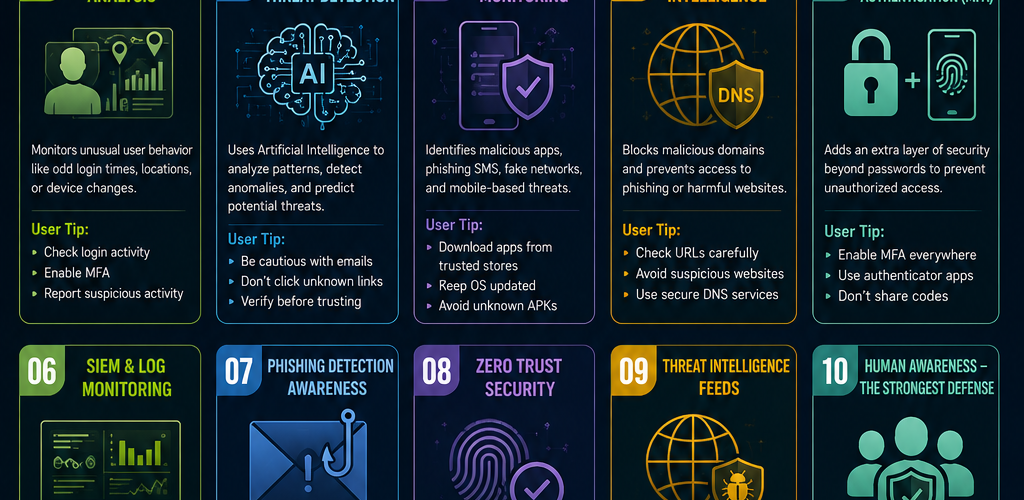
🚨 1. Behavioral Analysis – Watching for Unusual Activity
Cybersecurity tools today focus less on signatures and more on behavior.
For example:
If you usually log in from Karachi between 9 AM and 6 PM, and suddenly your account logs in from another country at 3 AM, the system may flag it as suspicious.
What users should do:
✅ Review login notifications
✅ Check account activity regularly
✅ Enable multi-factor authentication (MFA)
🤖 2. Artificial Intelligence (AI) Threat Detection
Artificial Intelligence is becoming a powerful cybersecurity ally.
Modern security systems can:
- Detect unusual emails
- Identify suspicious website links
- Analyze millions of logs instantly
- Predict potential cyber attacks
AI helps security teams find threats faster than manual monitoring.
Daily Tip:
Never assume an email is safe just because it looks professional.
Always verify before clicking.
📱 3. Mobile Security Monitoring
Most people spend more time on mobile phones than computers.
Cybercriminals know this.
Common mobile threats include:
❌ Fake banking apps
❌ WhatsApp scams
❌ SMS phishing (Smishing)
❌ QR code fraud
Protection Tips:
✔ Download apps only from trusted stores
✔ Update your phone regularly
✔ Avoid unknown APK files
🌐 4. DNS Threat Intelligence
Many cyber attacks start when users unknowingly visit malicious websites.
DNS Security solutions can:
- Block malicious domains
- Prevent phishing attacks
- Identify suspicious traffic patterns
User Awareness:
Before entering credentials:
🔍 Check the website URL carefully.
A fake website often differs by only one letter.
🔐 5. Multi-Factor Authentication (MFA)
Passwords alone are no longer sufficient.
Cybersecurity professionals now recommend:
✔ Password + Mobile Verification
✔ Password + Authentication App
✔ Password + Biometric Authentication
Even if hackers steal your password, MFA creates an additional security barrier.
📊 6. Security Information and Event Management (SIEM)
Large organizations use SIEM platforms to monitor:
- Login attempts
- Failed authentications
- Malware detections
- Firewall events
These tools help security teams identify attacks before they cause damage.
Real-World Example:
A user account receives 500 failed login attempts within minutes.
SIEM immediately alerts the security team.
The account is protected before compromise occurs.
📧 7. Phishing Detection Awareness
Phishing remains one of the most successful attack methods worldwide.
Typical warning signs:
🚩 Urgent payment requests
🚩 Suspicious attachments
🚩 Fake Microsoft login pages
🚩 Requests for passwords
Golden Rule:
When in doubt:
📞 Call and verify.
Never trust unexpected requests involving money or credentials.
🛡️ 8. Zero Trust Security
The modern cybersecurity principle is:
“Never Trust, Always Verify.”
Even users inside a network should be verified continuously.
Organizations are increasingly implementing:
- Identity Verification
- Device Verification
- Access Controls
- Least Privilege Models
🔥 9. Threat Intelligence Feeds
Organizations now subscribe to threat intelligence services that provide:
- New malware indicators
- Malicious IP addresses
- Active phishing campaigns
- Emerging attack trends
This proactive approach helps organizations stay ahead of attackers.
👨💻 10. Human Awareness – The Strongest Defense
Technology helps.
But users remain the first line of defense.
Most cyber incidents can be prevented through:
✔ Awareness
✔ Verification
✔ Safe browsing habits
✔ Regular updates
✔ Continuous learning
Cybersecurity is not only an IT department responsibility.
It is everyone’s responsibility.
Final Thoughts
Cyber threats continue to evolve every day.
Fortunately, cybersecurity is evolving even faster.
By understanding emerging techniques such as AI-based threat detection, behavioral analytics, mobile security monitoring, and Zero Trust security, individuals and organizations can significantly reduce their risk.
The safest organizations are not the ones with the most expensive tools.
They are the ones with informed and vigilant users.
Remember:
🛡️ Cybersecurity is not a product. It is a mindset.
About NextGen Wisdom Pakistan
NextGen Wisdom Pakistan is committed to empowering students, engineers, IT professionals, and future technology leaders through practical learning, career guidance, cybersecurity awareness, and emerging technology insights.
#CyberSecurity #CyberAwareness #InformationSecurity #ThreatDetection #CyberThreats #DigitalSafety #TechnologyAwareness #AIinCyberSecurity #NextGenWisdomPakistan #CyberDefense #SOCAnalyst #ITSecurity #CyberEducation #PakistanIT #FutureTech