
Blog
The First Job Is Not Just a Job — It Is the Start of Professional Formation
NEXTGEN WISDOM PAKISTAN
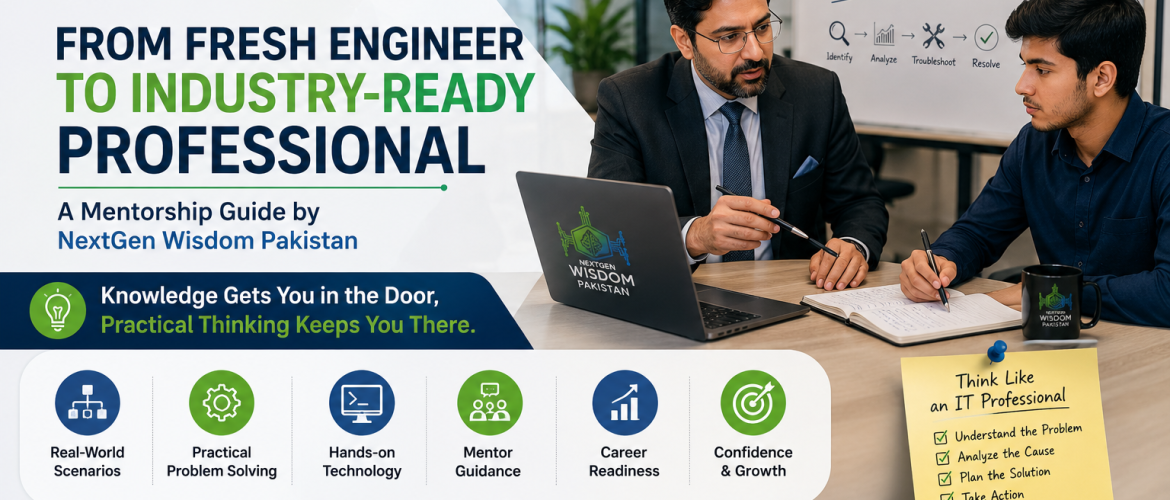
From Fresh Engineer to Industry-Ready Professional
Why Practical Mentorship Matters at the Beginning of an Engineering Career
NextGen Wisdom Pakistan | Bridging Knowledge, Innovation & IT Wisdom into Real-World Solutions
For a fresh engineer, entering the professional world can be exciting and confusing at the same time. A new engineer may understand networking, operating systems, databases, electronics, programming, cloud platforms or other technical subjects from university. Yet the workplace introduces a different set of questions: Where do I start when something fails? How do I decide what to check first? What should I change in a production environment—and what should I never change without approval? How do I explain a technical problem to a manager or non-technical user? How do I learn from a senior engineer without becoming dependent on them?
These are professional-judgement questions, not simply textbook questions.
Structured mentorship can support confidence, professional identity, reflection, communication and career readiness; its technical and employment impact depends on how the mentoring experience is designed and applied. In Pakistan, structured graduate training is also being used to connect academic preparation with field exposure and professional skills development.
The Real Gap: Knowing Technology vs. Applying Technology
A fresh engineer may know the definition of DNS. An IT professional needs to know how to troubleshoot DNS when a business application cannot be reached.
A graduate may know what a firewall is. A professional needs to investigate a blocked connection without unnecessarily weakening security.
A graduate may know that a server has CPU, RAM and storage. A professional needs to decide whether high CPU is the cause of an outage, a symptom, or simply normal workload.
This is the practical gap. It is the natural difference between learning concepts and operating in an environment where systems are interconnected and business continuity matters. Mentorship helps make that transition safer and more structured.
What Practical Mentorship Actually Means
Mentorship should not mean giving a fresh engineer a list of commands to memorize. It should mean teaching the engineer how to think.
UNDERSTAND → OBSERVE → PRACTICE → TROUBLESHOOT → EXPLAIN → IMPROVE
- Understand the purpose of a technology before using the tool.
- Observe how experienced professionals approach a real task.
- Practice through controlled scenarios and labs.
- Troubleshoot systematically instead of guessing.
- Explain the problem and proposed solution clearly.
- Review mistakes and improve the next attempt.
The objective is not to create a person who always asks the mentor for the answer. The objective is to develop a professional who eventually knows how to find the answer independently.
A Mentor’s Role: Guide the Thinking, Not Just the Task
A strong technical mentor does more than say, “Run this command.” Instead, the mentor asks: “What are you trying to prove?”
For an Internet complaint, a mentor can guide the engineer through:
Scope → Endpoint → Local Network → External Connectivity → DNS → Application → Verification
- Is one user affected or everyone?
- Does the computer have a valid IP address?
- Can it reach the gateway?
- Can it reach an external IP?
- Can a domain name be resolved?
- Is the actual application available?
- Does the user’s service work after the fix?
The engineer learns more than a troubleshooting command. They learn a reusable way of thinking.
Practical Mentorship Through Real IT Scenarios
Scenario 1 — VICIdial / Call Center
An agent reports: “I am logged in, but I am not receiving calls.” The engineer learns to investigate Agent status → Campaign → Leads → Dialing activity → Phone/WebRTC/SIP → Asterisk → SIP trunk → Server resources → Logs. The lesson is how to isolate a fault inside a chain of dependent systems.
Scenario 2 — MikroTik / Network Outage
Several employees lose Internet access. The engineer checks scope, gateway reachability, WAN status, WAN address, default route, NAT, DNS, firewall rules, recent changes and ISP/upstream connectivity before making a controlled fix.
Scenario 3 — CCTV Surveillance
Several cameras disappear from an NVR. The engineer looks for a common point: Camera → PoE → Switch → Uplink → Network/VLAN → NVR → Storage. Multiple failures often point to shared infrastructure.
Scenario 4 — File / Sharing Server
A user can see a shared folder but cannot open files. The engineer checks authentication, user/group membership, Share permissions, NTFS permissions, inheritance and file-level restrictions rather than giving unnecessary Administrator access.
Scenario 5 — Linux Server
A business service is unavailable. The engineer checks network, CPU, memory, disk, processes, service status, dependencies and logs before considering a restart. Typical tools include ip addr, ip route, ping, df -h, free -h, top, systemctl and journalctl.
Scenario 6 — Windows Server
A user cannot access a business resource. The engineer investigates the user account, network, DNS, server availability, service status, permissions and Windows Event Logs, with Active Directory, DNS, DHCP, Group Policy and file services considered where relevant.
The Mentor Should Create Safe Failure
Fresh engineers need permission to make mistakes—but not in a way that damages production systems. A good mentoring environment separates learning from production.
- Learning: labs, simulations, test machines, controlled configurations and sample incidents.
- Production: real users, real data, business-critical services, approvals, backups, monitoring and rollback plans.
Practice boldly in a controlled environment; change production carefully.
From “What Is It?” to “How Would You Handle It?”
| Learning Stage | Example |
| Knowledge | What is DHCP? |
| Understanding | What information does DHCP provide? |
| Application | A client has no IP. What would you check? |
| Troubleshooting | One PC has no IP while others work. How do you isolate it? |
| Professional judgement | You are on night shift and 50 users report network failure. What do you check first, what do you change, and when do you escalate? |
The Five Habits We Want Fresh Engineers to Develop
1. Ask Better Questions
What is the actual symptom? Who is affected? When did it start? What changed? What is still working?
2. Think in Layers
Physical → Network → Operating System → Service → Application → User.
3. Use Evidence
Logs, monitoring, ping tests, service status, resource usage and configuration information are more reliable than assumptions.
4. Communicate Clearly
Problem → Impact → Evidence → Root Cause → Action → Result.
5. Document the Learning
What happened? What caused it? How was it diagnosed? What fixed it? How can recurrence be prevented?
Mentorship Is Also About Professional Behaviour
Technical knowledge is only part of becoming industry-ready. Fresh engineers also need communication, time management, teamwork, critical thinking, professional discipline, documentation, ownership, escalation judgement and ethical decision-making.
A Pakistan-focused study of engineering employability found a perception gap between graduates and employers, with employers placing strong importance on thinking, interpersonal and communication-related skills alongside technical ability.
A Practical Mentorship Roadmap for Fresh Engineers
| Stage | Focus | Expected Development |
| 1. Foundation | Core concepts and terminology | Understands the technology. |
| 2. Observation | Watch real troubleshooting and decisions | Understands professional workflow. |
| 3. Guided Practice | Labs and controlled scenarios | Performs tasks with guidance. |
| 4. Independent Practice | Scenario-based troubleshooting | Investigates problems independently. |
| 5. Review | Mentor feedback and reflection | Understands mistakes and improves. |
| 6. Professional Readiness | Communication, documentation and escalation | Operates responsibly in a workplace. |
What Success Looks Like
Successful mentorship is not when a fresh engineer can repeat everything the mentor said. Success looks like this:
PROBLEM → SCOPE → EVIDENCE → LIKELY LAYER → TEST → CONTROLLED FIX → VERIFY → DOCUMENT
The mentor gradually becomes less necessary for routine decisions because the engineer’s own judgement becomes stronger.
Why NextGen Wisdom Pakistan Focuses on the Bridge
NextGen Wisdom Pakistan is built around a simple belief: learning should connect to reality.
For fresh engineers, that means moving beyond Degree → Certificate → CV and toward Knowledge → Practical Exposure → Mentorship → Problem Solving → Professional Confidence.
The platform’s purpose is to help connect what a fresh engineer has studied with what an organization expects the engineer to handle. This means using practical scenarios, technical discussions, guided problem-solving, career guidance and reflection—not simply collecting information.
A Message to Every Fresh Engineer
Your first few months in the professional world may feel uncomfortable. You may know the theory but hesitate when facing a real incident. You may know the command but not know whether it is safe to run. You may understand the technology but struggle to explain the problem.
That is normal.
Do not be afraid to ask questions—but learn to ask better questions. Do not be afraid of mistakes—learn from them safely. Do not compare your first month with someone’s tenth year.
Build your fundamentals. Practice. Observe experienced professionals. Document what you learn. And most importantly: do not try to become an expert overnight. Try to become better every day.
Our Mentorship Philosophy
At NextGen Wisdom Pakistan, our goal is not simply to tell fresh engineers what to learn. We aim to help them understand what to learn, why it matters, how it is used, how it fails, how to troubleshoot it, how to communicate about it, and how to keep learning when technology changes.
The strongest early-career advantage is not knowing every technology. It is developing the ability to learn, investigate, solve and adapt.
The Next Generation Starts With Practical Wisdom
NextGen Wisdom Pakistan
Bridging Knowledge, Innovation and IT Wisdom into Real-World Solutions.
Learn Practically. Think Critically. Solve Confidently. Grow Professionally.
About NextGen Wisdom Pakistan
NextGen Wisdom Pakistan is a knowledge-driven initiative focused on helping Pakistan’s youth, fresh graduates, engineers and IT professionals develop practical technology knowledge and professional confidence. Our content focuses on real-world technology, practical scenarios, career development, IT infrastructure, cybersecurity, AI, cloud computing, networking, system administration and digital transformation.
Backed by Rs Comm Solution’s IT experience, the initiative aims to connect learning with practical industry thinking.
Join the Conversation
WhatsApp: +92 300 263 27 28
LinkedIn: NextGen Wisdom Pakistan
Website: NextGenWisdomPakistan.com